
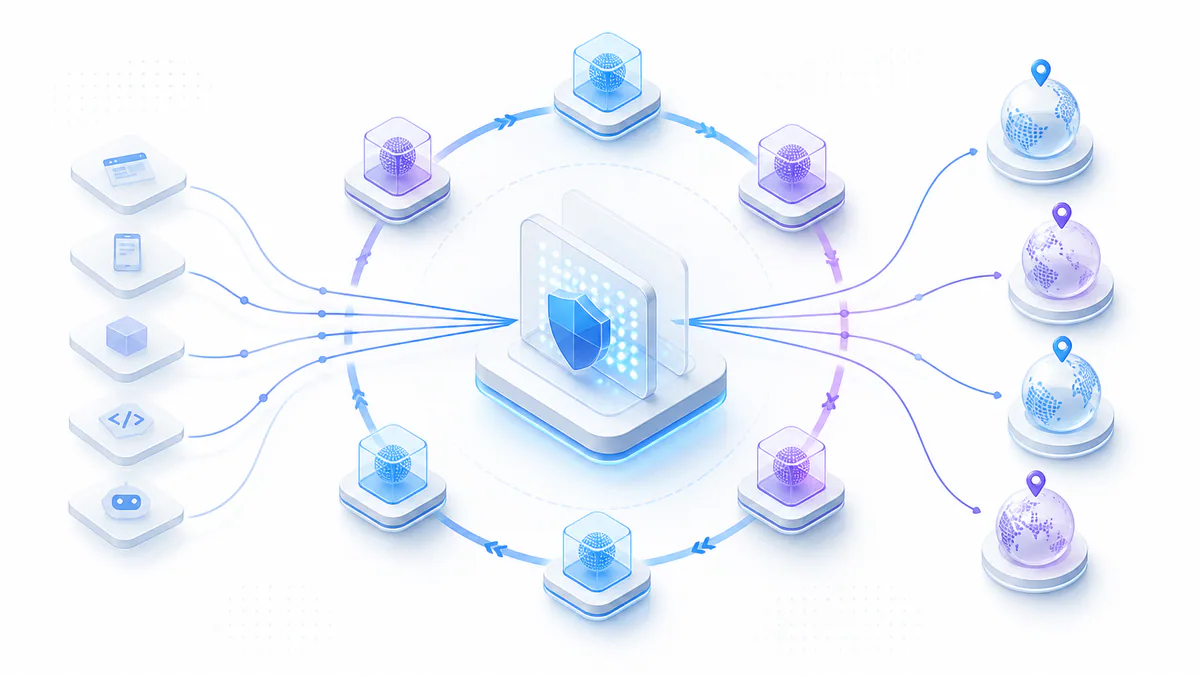
A rotating proxy automatically changes the proxy IP used for your outbound requests. Instead of sending everything through one static address, the system selects exits from a proxy pool. Rotation can happen for every request or connection, after a time interval, or when a sticky session expires.
| Core behavior | The exit proxy IP changes automatically over time |
|---|---|
| Common rotation modes | Per request, per connection, timed, or sticky session |
| IP source | Datacenter, residential, mobile, or ISP proxy pools |
| Common access model | One managed gateway or a client-managed proxy list |
| Best suited for | High-volume, repeatable, and distributed outbound requests |
| Not ideal for | Workflows that require one permanent or allowlisted IP |
- A rotating proxy automatically changes the exit IP used for your requests instead of keeping every request on one fixed proxy address.
- “Rotating” describes behavior, not the source of the IP. Datacenter, residential, mobile, and ISP proxies can all be configured to rotate.
- Rotation can happen on every request, every new connection, after a time interval, or only when a sticky session expires.
- A backconnect gateway is a common way to deliver rotating proxies, but rotation can also be implemented by the client using a proxy list.
- Rotating proxies are most useful when many independent requests need IP distribution; they can be a poor fit for permanent-IP, allowlisting, or long-lived identity workflows.
What Are Rotating Proxies?
A rotating proxy is a proxy service or configuration that automatically changes the IP address used to send your outbound requests. Instead of routing every request through one fixed proxy IP, the system selects addresses from a larger proxy pool according to a rotation rule.
The rotation can be aggressive or persistent. Some systems choose a new exit for every request or connection. Others keep one IP for a defined time window or session and rotate only after that session expires. This means “rotating proxy” is an umbrella term for several IP-selection strategies rather than one single protocol.
The key distinction is that rotating describes what the exit IP does. It does not tell you whether the underlying addresses are datacenter, residential, mobile, or ISP proxies, and it does not automatically mean the service uses a backconnect gateway.
Definition
The simplest definition is: a rotating proxy automatically changes the outbound proxy IP used by your application according to a rotation policy.
What Is a Rotating Proxy Server?
A rotating proxy server is the infrastructure that accepts proxy traffic and assigns or forwards that traffic through changing exit addresses. In a managed service, the customer may see only one gateway hostname and port while the provider manages the larger IP pool behind it.
In a client-managed setup, there may be no dedicated rotation gateway. Your own application can store a proxy list and choose a different IP before each request. Both approaches create rotating behavior, but the responsibility for selection and health management is different.
Rotating Proxy vs. Rotating IP
A rotating IP is the network identity that changes. A rotating proxy is the service or configuration that causes requests to use those changing identities. The terms are closely related, but a proxy service can expose thousands of rotating IPs behind one connection endpoint.
How Do Rotating Proxies Work?
Rotating proxies work by separating the client connection from the exit IP selection. Your application sends traffic to a proxy endpoint or chooses an address from a proxy list, and a rotation rule determines which IP should be used for the next outbound connection.
In managed gateway services, the gateway can centralize authentication, pool selection, session mapping, health checks, failure handling, connection limits, bandwidth accounting, and protocol support. In a client-side implementation, some or all of those responsibilities belong to your own code.
The Proxy Pool
A proxy pool is the collection of IP addresses available for selection. Pool quality matters more than a headline number alone. A useful pool needs enough healthy and relevant exits for the requested locations, protocols, concurrency, and workload.
Providers can organize pools by country, region, network type, product tier, or account. Rotation then happens inside the selected pool rather than across every IP the provider owns.
The Rotation Policy
The rotation policy answers a simple question: should the next request keep the existing exit or receive another one? A per-request workflow changes frequently, while a sticky workflow intentionally preserves an IP for related requests.
Health Checks and Failover
A production rotating proxy system should account for backend failures. If an exit repeatedly times out or refuses connections, the service can stop assigning new traffic to it, allow it to cool down, and test it again later.
Failover improves operational resilience, but it does not guarantee that every destination will accept every exit. Success can still vary by target, IP history, geography, request pattern, and destination-side rules.
Rotating Proxy Methods: Per-Request, Timed, and Sticky
The biggest practical decision is how frequently the proxy should change. Current rotating proxy services generally expose one or more of four patterns: per-request rotation, per-connection rotation, time-based rotation, and sticky sessions.
The correct choice depends on whether requests are independent. Stateless data collection can tolerate frequent changes. Multi-step sessions usually need temporary IP consistency.
| Rotation Method | IP Behavior | Best Fit | Main Tradeoff |
|---|---|---|---|
| Per request | A new exit may be selected for every request | Independent high-volume requests | Can break session continuity |
| Per connection | A new exit is selected for each new TCP/proxy connection | Short-lived connection workflows | Keep-alive can preserve the same exit longer |
| Time-based | IP is kept for a configured time window | Balanced rotation and continuity | Exact change timing may vary by provider |
| Sticky session | Same exit is preserved for a session identifier or duration | Logins, carts, multi-step workflows | Exit can still fail or expire |
Per-Request Rotation
Per-request rotation is the most aggressive model. A simplified sequence is Request 1 → IP A, Request 2 → IP B, Request 3 → IP C. This makes it useful when each request can stand alone.
Do not assume every provider literally guarantees a unique address on every request. Pool size, availability, session behavior, connection reuse, and provider logic can cause an IP to reappear.
Per-Connection Rotation
Some services rotate when a new proxy connection is created rather than for every HTTP request. If an application reuses a keep-alive connection, several requests may therefore leave through the same exit until that connection closes.
Time-Based Rotation
Time-based rotation keeps an exit for a configured interval such as one, five, or ten minutes. It reduces unnecessary IP changes while still moving longer-running workloads across the pool.
Sticky Sessions
A sticky session intentionally keeps the same proxy IP for related requests. Providers may implement stickiness with a session token, username parameter, dedicated port, or internal session mapping.
Sticky is not the opposite product category of rotating proxies; it is usually a rotation mode within a rotating proxy service. Once the session ends, expires, or loses its backend, the service can assign another exit.
Managed Gateway Rotation vs. Client-Side Proxy Rotation
Rotating proxies can be delivered in two main ways. A managed gateway performs the selection for you. A client-side proxy list leaves selection logic inside your application.
The managed approach is simpler for large fleets of workers because the provider can change the backend pool without forcing every worker to download a new proxy list. The client-side approach provides more direct control over specific IP addresses and custom selection logic.
Related architecture
When one gateway manages the changing backend pool, that delivery model is commonly called a backconnect proxy. Read What Are Backconnect Proxies?
| Area | Managed Gateway | Client-Side Proxy List |
|---|---|---|
| Client configuration | Usually one hostname and port | Many individual proxy endpoints |
| Who selects the exit? | Provider gateway | Your application |
| Health management | Often provider-managed | Usually your responsibility |
| Sticky sessions | Often built in | You implement mapping yourself |
| Specific IP control | Usually lower | Usually higher |
| Scaling configuration | Simple for many workers | Requires proxy-list distribution |
| Best fit | Managed rotation at scale | Custom routing and exact proxy selection |
Types of Rotating Proxies
Rotation describes behavior, so the underlying proxy addresses can come from different network types. Each category has different performance, cost, availability, and network-identity characteristics.
The right choice depends on the destination and workload rather than on rotation alone.
| Proxy Type | Typical Strengths | Typical Tradeoffs | Common Fit |
|---|---|---|---|
| Rotating datacenter proxies | High throughput, low latency, scalable concurrency, lower cost | Clearly associated with hosting/datacenter networks | Scraping, monitoring, automation, testing |
| Rotating residential proxies | Consumer ISP address space and broad location coverage | Higher cost, often bandwidth-priced, more variable performance | Geo-sensitive public data collection and testing |
| Rotating mobile proxies | Carrier-associated IP space | High cost and lower available capacity | Mobile-specific validation and research |
| Rotating ISP proxies | Hosted performance with ISP-associated address space in many products | Definitions and availability vary by provider | Longer-lived or stable session workflows |
Rotating Datacenter Proxies
Rotating datacenter proxies use IP addresses hosted on server and datacenter infrastructure. They are typically optimized for speed, throughput, high concurrency, and predictable operations.
They are often a strong fit for public-web monitoring, SEO checks, browser testing, automation, and large datasets where cost per request and connection performance matter.
Rotating Residential Proxies
Rotating residential proxies use IP addresses associated with consumer internet providers. Large residential products are frequently delivered through a gateway because the available endpoints can change dynamically.
They are usually more expensive than datacenter proxies and are commonly priced by bandwidth rather than by concurrent connection allowance.
Rotating Mobile Proxies
Rotating mobile proxies route traffic through mobile-carrier-associated IP space. They can be useful for mobile-specific research and testing, but they tend to be more expensive and capacity-constrained.
Rotating ISP Proxies
ISP proxy products typically combine hosted infrastructure with address space associated with internet service providers. Vendor terminology varies, so confirm whether the service is static, rotating, dedicated, shared, or session-based before buying.
Rotating Proxies vs. Static Proxies
The simplest comparison is identity persistence. A static proxy keeps one IP address. A rotating proxy changes the exit according to a rule. Neither is universally better.
Static proxies are useful when a workflow needs one stable identity, allowlisting, or long-lived sessions. Rotating proxies are useful when a large number of independent requests benefit from distribution across multiple exits.
| Feature | Rotating Proxy | Static Proxy |
|---|---|---|
| Exit IP | Changes automatically | Remains fixed |
| IP pool | Usually multiple addresses | One assigned address or small fixed set |
| Session continuity | Requires sticky mode when needed | Naturally stable |
| IP allowlisting at destination | Usually difficult | Well suited |
| Large independent request volume | Strong fit | Can overconcentrate traffic on one IP |
| Management | Provider or client rotates pool | Simpler single-IP configuration |
Rotating Proxies vs. Backconnect Proxies
Rotating and backconnect are related but describe different things. Rotating describes the IP-changing behavior. Backconnect describes a common gateway architecture used to deliver a proxy pool.
A backconnect service is usually rotating, but rotating proxies do not have to use a backconnect gateway. Your own script can rotate a list of individual proxy endpoints and still create a rotating proxy setup.
Keeping this distinction clear prevents keyword and content overlap: this guide focuses on rotation behavior, while the dedicated Backconnect guide explains the one-gateway architecture in depth.
Backconnect guide
For gateway selection, backend pools, sticky mapping, and one-endpoint architecture, continue with What Are Backconnect Proxies?
Benefits of Rotating Proxies
The main benefit of proxy rotation is traffic distribution. Instead of repeatedly using one network identity, requests can be spread across a broader pool.
The value becomes more noticeable as request volume and worker count increase, because one static proxy can become a bottleneck for concurrency, rate limits, availability, and operational resilience.
Request Distribution
Rotation spreads outbound requests across several proxy IPs. This reduces dependence on one address and can make large request queues easier to distribute operationally.
Scalability
A larger proxy pool can support many independent workers without every worker sharing the same fixed exit. Practical scalability still depends on account limits, backend capacity, destination behavior, and application design.
Resilience to Individual Proxy Failures
If one exit is unavailable, a managed rotation service can assign another healthy proxy for later requests. This can reduce downtime caused by individual backend failures.
Location Flexibility
Providers may expose country or regional pools so that separate sessions can use different locations without manually maintaining a proxy list for every region.
Less Proxy-List Management
With a managed gateway, customers do not need to distribute and constantly update every backend IP in their applications. The provider can manage pool changes behind a stable endpoint.
Limitations and Drawbacks of Rotating Proxies
Rotating proxies are not a universal solution. Frequent IP changes can make some workflows less stable, and a new IP does not automatically change every other signal a website can observe.
A useful 2026 guide should treat rotation as one infrastructure tool rather than as a guarantee of access or anonymity.
Rotation Can Break Sessions
Changing the exit IP during a login, cart, checkout, or multi-step browser flow can create inconsistent session behavior. Use sticky sessions when related requests need temporary identity continuity.
Shared Pool Reputation Varies
In shared pools, exit IPs can have different histories and destination-specific reachability. A large pool does not guarantee identical quality for every address.
A Proxy Adds Network Overhead
Every proxy hop adds network distance and processing. Latency can be affected by gateway location, exit location, target location, DNS behavior, TLS negotiation, congestion, and backend load.
Rotation Does Not Change Browser Fingerprints
A new proxy IP does not automatically change cookies, TLS characteristics, browser fingerprints, headers, account history, or behavioral patterns. Applications need to treat IP rotation as only one part of a broader request and session design.
Exact Exit Control May Be Limited
Managed rotating services often optimize convenience over exact IP selection. If you must pin a specific address, a dedicated static proxy or client-managed list can provide better control.
Common Rotating Proxy Use Cases
Rotating proxies are most useful when an application makes many legitimate outbound requests and does not need every request to originate from one permanent IP.
Use them in accordance with applicable law, target-site rules, access permissions, and responsible request-rate practices.
Rotating Proxies for Web Scraping
Public-data crawlers can use proxy rotation to distribute independent requests across a pool instead of sending an entire crawl from one IP. Sticky sessions can preserve temporary continuity when a page flow requires several related requests.
Rotation should be paired with sensible concurrency, retries, timeouts, caching, and request pacing. Sending more requests simply because more IPs are available is not a substitute for responsible crawler design.
SEO and SERP Monitoring
Rank trackers and SEO monitoring systems generate repeated search and page requests across keywords and regions. Rotating proxies can help distribute those jobs and connect through different geographic proxy pools.
Price Monitoring
E-commerce monitoring tools can distribute scheduled checks across product catalogs and regional proxy pools while keeping the application configuration centralized.
Ad Verification
Ad-verification workflows can use regional proxy exits to inspect public landing pages and campaign behavior from different network locations.
Browser Automation and QA
Automated browsers can use rotating proxies for localization testing, public page checks, QA, and workflows where separate browser sessions should use different network identities.
Market, Review, and Content Monitoring
Large monitoring systems can centralize outbound routing for news, reviews, pricing, competitor pages, and other public-content checks instead of assigning one permanent proxy to the entire workload.
When Should You Not Use Rotating Proxies?
There are several common situations where a static or dedicated proxy is simpler and more reliable than rotation.
Consider a static proxy instead when
- A third party must allowlist one exact source IP.
- Your workflow needs a long-lived network identity and no adequate sticky-session option is available.
- You need to select and control one exact proxy address for each task.
- The workload is very small and rotating a larger managed pool adds unnecessary complexity.
- The application is sensitive to added gateway or proxy latency.
- Frequent changes would make a legitimate authenticated workflow look inconsistent.
How to Use Rotating Proxies
A managed rotating proxy is usually configured like any other proxy endpoint. The application connects to a host and port, authenticates, and lets the service choose the exit according to the configured rotation mode.
Exact formats vary between providers. The examples below use placeholder credentials and an IP-echo endpoint so you can verify which exit address is visible.
ProxyTitan
For high-speed automatic datacenter IP rotation, see ProxyTitan Rotating Datacenter Proxies
Rotating Proxy Gateway Format
Credential-based services commonly use username:password@host:port. IP-authenticated services can use just host:port after the client IP has been authorized.
username:[email protected]:8000gateway.example.com:8000cURL Example
This example sends one request through an HTTP(S) rotating proxy gateway. Repeating the command can show a different exit when the provider uses per-request or per-connection rotation.
curl -x "http://username:[email protected]:8000" \
  "https://api.ipify.org?format=json"
Python requests Example
Python requests can reuse the same gateway string while the proxy provider rotates the backend exit. If the service rotates only on a new connection, avoid assumptions about keep-alive behavior and verify the actual result.
import requests

proxy = "http://username:[email protected]:8000"

proxies = {
    "http": proxy,
    "https": proxy,
}

for i in range(5):
    response = requests.get(
        "https://api.ipify.org?format=json",
        proxies=proxies,
        timeout=15,
    )
    response.raise_for_status()
    print(i + 1, response.json())
SOCKS5 Example
If the provider exposes SOCKS5, the same rotation concept can apply to SOCKS connections. The socks5h scheme makes cURL resolve the destination hostname through the proxy.
curl --proxy "socks5h://username:[email protected]:1080" \
  "https://api.ipify.org?format=json"
How to Test a Rotating Proxy
Do not rely only on a provider’s marketing description. A simple test can confirm whether the exit changes, how often it changes, how many unique addresses appear, and how stable the requests are.
For a useful benchmark, document the request count, protocol, rotation mode, concurrency, test date, successful requests, unique exit count, and latency statistics. Avoid publishing invented numbers.
Rotation Test Methodology
Start with sequential requests to understand the basic rotation pattern. Then test realistic concurrency separately if throughput matters. If the provider offers sticky sessions, repeat several requests under one session token and verify that the exit remains stable for the expected duration.
Useful metrics
- Requests attempted and requests completed.
- Unique exit IP addresses observed.
- Success rate.
- Median and P95 response time.
- Rotation mode used.
- HTTP(S) or SOCKS5 protocol.
- Session duration when sticky rotation is tested.
Python Rotation Test
The following script records the visible exit and latency for repeated requests through one gateway.
import time
import requests

proxy = "http://username:[email protected]:8000"
proxies = {"http": proxy, "https": proxy}

observed_ips = []
latencies = []

for i in range(20):
    started = time.perf_counter()

    try:
        response = requests.get(
            "https://api.ipify.org?format=json",
            proxies=proxies,
            timeout=15,
        )
        response.raise_for_status()

        elapsed_ms = (time.perf_counter() - started) * 1000
        exit_ip = response.json()["ip"]

        observed_ips.append(exit_ip)
        latencies.append(elapsed_ms)

        print(
            f"{i + 1:02d}  "
            f"ip={exit_ip:<15}  "
            f"latency={elapsed_ms:.0f}ms"
        )

    except requests.RequestException as exc:
        print(f"{i + 1:02d}  error={exc}")

print("successful:", len(observed_ips))
print("unique IPs:", len(set(observed_ips)))

if latencies:
    print("average latency:", round(sum(latencies) / len(latencies), 1), "ms")
Publish Real ProxyTitan Rotation Results
For the final live article, a first-party benchmark is one of the strongest improvements you can add. Run the same documented test against ProxyTitan and publish the actual results with the date and configuration.
That gives the article original evidence instead of repeating the same generic explanation found across many rotating-proxy guides.
Rotating Proxy Best Practices for 2026
Reliable proxy rotation depends as much on application behavior as on the IP pool. A strong implementation keeps session state, retries, concurrency, monitoring, and target-specific rules explicit.
Practical best practices
- Use per-request rotation only when requests are genuinely independent.
- Use sticky sessions for login, cart, multi-step, or cookie-dependent workflows.
- Set realistic connect and read timeouts instead of allowing failed requests to hang indefinitely.
- Use bounded retries with backoff rather than retrying the same failing request forever.
- Track success rate and latency by target, proxy type, and rotation mode.
- Respect concurrency limits on both your proxy plan and the destination service.
- Do not assume a new IP resets cookies, browser state, TLS fingerprints, or account-level reputation.
- Prefer real measured success rates over advertised pool size when comparing providers.
- Keep use compliant with applicable law, authorization, and destination rules.
How to Choose a Rotating Proxy Provider
A strong rotating proxy provider should be evaluated on usable performance, not just the advertised number of IPs. Gateway reliability, pool quality, protocol support, rotation controls, concurrency, and observability can matter more than raw pool size.
Testing matters
Whenever possible, test the provider against your actual target workload before committing to a larger plan.
| Area | What to Check |
|---|---|
| Rotation control | Per-request, timed, sticky, session identifiers, and connection behavior |
| Proxy type | Datacenter, residential, mobile, ISP, dedicated/shared model |
| Pool quality | Healthy usable exits, locations, diversity, and replacement behavior |
| Gateway reliability | Connection stability, uptime, failover, and maintenance history |
| Concurrency | Account thread/connection limits and enforcement |
| Protocols | HTTP, HTTPS CONNECT, SOCKS5, DNS handling, IPv4/IPv6 if relevant |
| Authentication | Username/password, IP authorization, credential controls |
| Bandwidth | Included traffic, fair-use rules, throughput limits, and overages |
| Observability | Usage statistics, error visibility, documentation, support, status information |
| Pricing | Cost relative to usable success rate, bandwidth, concurrency, and operational effort |
Conclusion: Are Rotating Proxies the Right Choice?
Rotating proxies automatically change the exit IP used for outbound requests. They are especially useful for high-volume workflows where many independent requests benefit from being distributed across a proxy pool.
The most important design choice is not simply whether to rotate, but how. Per-request rotation is useful for stateless tasks, while timed or sticky sessions are better when related requests need temporary consistency.
Keep the terminology separate: rotating describes IP behavior, while backconnect describes one common gateway architecture. If your priority is fast managed datacenter rotation through one endpoint, ProxyTitan’s rotating datacenter and backconnect products are the relevant commercial options.
Next step
Explore Rotating Datacenter Proxies
Rotating Proxy FAQ
These answers cover the most common questions around rotating proxies, sticky sessions, proxy pools, static proxies, backconnect gateways, protocols, and web scraping.
Need fast automatic IP rotation through one managed endpoint?
ProxyTitan rotating datacenter proxies are built for high-throughput automation, monitoring, scraping, testing, and other legitimate workflows that benefit from automatic IP rotation.