
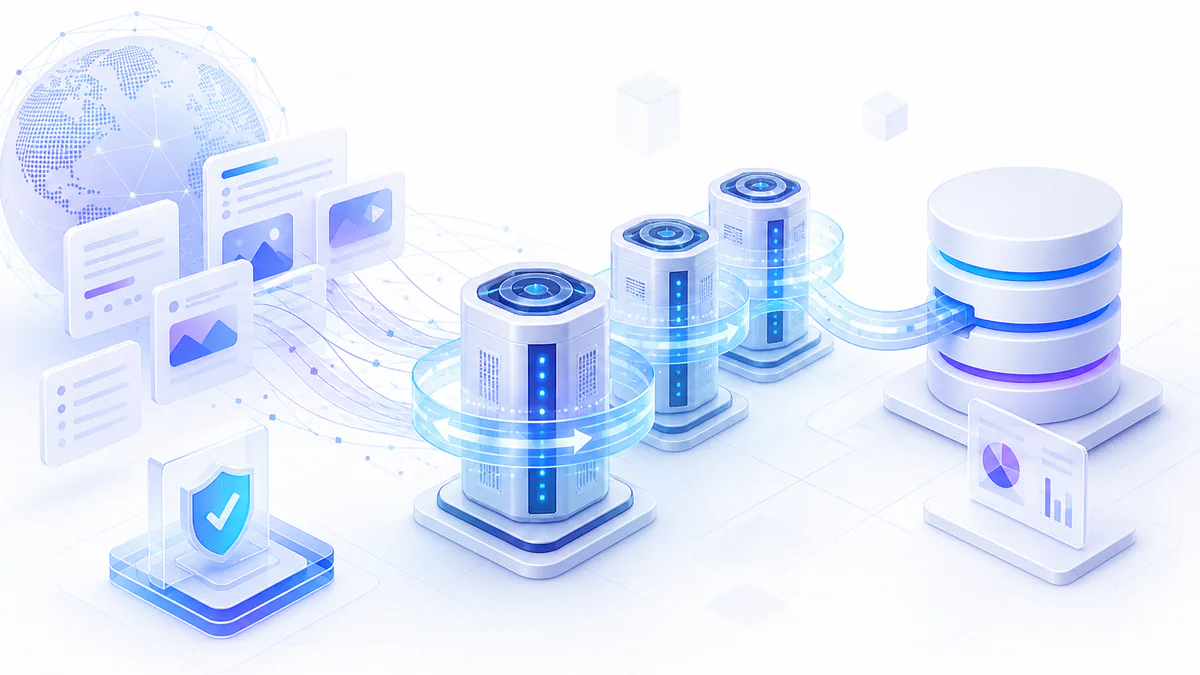
Web scraping often becomes difficult when websites detect repeated access from the same IP address. IP bans, CAPTCHAs, slow connections, and access blocks can reduce scraping success.
Rotating datacenter proxies solve many of these issues by providing fast infrastructure, frequent IP rotation, scalable request handling, and unlimited bandwidth options for larger data collection workflows.
This guide covers the most important tips for improving web scraping with rotating datacenter proxies, including IP diversity, proxy automation, bandwidth planning, and smarter extraction methods.
- Rotating datacenter proxies help reduce IP bans by changing the visible IP address across requests.
- Datacenter proxies are usually faster and more cost-effective than residential proxies for bulk scraping.
- Unlimited bandwidth is useful for high-volume scraping and continuous data collection.
- Automation, IP diversity, and smart extraction logic improve scraping reliability.
Introduction: The Challenges of Web Scraping with Rotating Datacenter Proxies
Web scraping faces many challenges. Users often run into IP bans, slow loading, blocked access, CAPTCHAs, and unstable data collection results.
Rotating datacenter proxies help solve these problems by using non-ISP affiliated IP addresses, fast network infrastructure, dynamic IP rotation, and scalable bandwidth for repeated requests.
A robust proxy network can also provide better anonymity, larger IP pools, and more stable access to public data for scraping, market research, SEO monitoring, and competitive analysis.
Residential proxies also exist, but they serve different needs. They can offer higher trust in some situations, while datacenter proxies usually offer better speed and lower cost for large-scale data extraction.
Key points:
- Web scraping challenges include IP bans, CAPTCHAs, slow pages, and access blocks.
- Rotating datacenter proxies provide fast speeds and scalable request handling.
- A diverse proxy pool improves anonymity and scraping stability.
- Residential proxies and datacenter proxies serve different scraping needs.
Scraping Challenges: IP Bans and Slow Connections
Web scraping can lead to blocked IPs and slower connections when a target website detects repeated access from one source.
A single IP address can become a clear signal of automation. This can trigger rate limits, CAPTCHAs, temporary blocks, or permanent bans.
Rotating proxy servers reduce these risks by frequently changing IP addresses. This makes requests look more distributed and helps avoid overusing one proxy identity.
For consistent scraping, users need stable connections, enough IP diversity, and reliable proxy health monitoring.
Primary takeaways:
- IP bans reduce scraping success rates.
- Slow connections hurt scraping efficiency.
- Repeated traffic from one IP increases detection risk.
- Stable proxy rotation improves long-term data retrieval.
Definition of Rotating Proxies
Rotating proxies are proxy servers that assign a new IP address with each request, each session, or after a user-defined interval.
This constant IP change improves anonymity and makes it harder for websites to link all requests to the same source.
When used responsibly, rotating proxies help users collect public data with fewer interruptions, better request distribution, and lower risk of IP-based blocking.
Benefits of Using Rotating Proxies
Rotating proxies are useful because they combine privacy, request distribution, and block resistance. They are especially helpful for scraping workflows that need many repeated requests.
Main benefits:
- Improved anonymity through constantly changing IP addresses.
- Increased security by avoiding repeated exposure of one direct IP.
- Lower chance of IP blocks during scraping and automation.
- Better scraping continuity through distributed request routing.
- Reduced risk of bans because each request can appear from a different proxy exit.
Why Rotating Datacenter Proxies?
Rotating datacenter proxies are popular because they are fast, affordable, and dependable for high-volume scraping.
They use a changing set of datacenter IPs to help users avoid detection while keeping response times low. For many scraping tasks, this balance of speed and scale is more practical than slower proxy types.
Advanced rotating datacenter proxy networks can provide anonymous IP access, targeting options, unlimited bandwidth, and enough capacity for continuous data extraction.
Related proxy option
Compare unlimited rotating datacenter proxies for high-volume scraping workflows.
Essential elements:
- Cost-effective for large scraping projects.
- High-speed connections and steady performance.
- Constant IP rotation helps reduce blocks.
- Unlimited bandwidth supports continuous data flow.
- Useful for high-volume public data collection.
Residential Proxies vs. Datacenter Proxies
Residential proxies use IP addresses assigned by real internet service providers. They can look more natural to some websites, but they often have higher costs, lower speeds, and bandwidth limits.
Datacenter proxies come from server infrastructure. They are usually faster, cheaper, easier to scale, and better suited for bulk scraping when maximum trust is not required.
Static proxies provide a fixed IP address and can be useful for sticky sessions, but using the same IP repeatedly can increase detection risk in scraping workflows.
Core features:
- Residential proxies use ISP-assigned IP addresses.
- Datacenter proxies provide fast routing and scalable bandwidth.
- Static proxies are useful for stable sessions but can increase detection risk.
- The best proxy type depends on target strictness, data volume, speed needs, and budget.
| Feature | Residential Proxies | Datacenter Proxies |
|---|---|---|
| IP Source | ISP-assigned with a natural appearance | Generated from datacenter infrastructure |
| Bandwidth | Often limited bandwidth | Often unlimited bandwidth options |
| Speed | Usually slower | Usually faster |
| Cost | Generally higher cost | More cost-effective for bulk scraping |
| Best Fit | Trust-sensitive targets | High-speed scraping and bulk data collection |
Tips for Enhanced Web Scraping
Rotating datacenter proxies work best when they are paired with smart scraping logic. Proxy rotation alone is not enough. You also need automation, IP diversity, bandwidth planning, and clean extraction methods.
Top 5 tips:
- Use proxy rotation for anonymity so each request does not reuse the same IP address.
- Leverage unlimited bandwidth to support large scraping jobs without traffic interruptions.
- Automate proxy switching in your scraper to reduce manual errors and improve reliability.
- Maintain IP diversity by monitoring proxy health and avoiding repeated use of weak IPs.
- Combine proxies with smart extraction techniques, clean parsing, and simple data structures.
Conclusion: Making the Informed Choice for Enhanced Web Scraping
Rotating datacenter proxies offer a practical solution for web scraping challenges by combining fast speeds, scalable bandwidth, and dynamic IP rotation.
The strongest results come from using proxies strategically. IP diversity, automatic switching, unlimited bandwidth, regular proxy health checks, and smart extraction methods all improve scraping reliability.
By comparing proxy types and applying these five tips, you can build a more stable and efficient data collection setup.
Primary takeaways:
- Rotating datacenter proxies can improve scraping performance.
- IP diversity and automation are key for reducing blocks.
- Unlimited bandwidth helps high-volume scraping workflows.
- Smart extraction logic improves data quality and efficiency.
Scraping with Rotating Datacenter Proxies FAQ
Need stable proxies for web scraping?
Use ProxyTitan when your scraping workflow needs fast rotating datacenter IPs, unlimited bandwidth options, private authentication, and reliable request routing.